Real Estate Coaching Programs: Industry Guide (2026)
How to Choose the Right Program, What It Costs, and Which Coaching Systems Deliver the Highest ROI
Introduction: Why Real Estate Coaching Matters Right Now
Today’s agents are operating in a more layered environment: multiple lead channels, constant platform changes, higher consumer expectations, and market conditions that can swing quickly based on rates and local inventory. For newer agents, it can feel like there are endless “right answers,” and for experienced agents, it can feel like yesterday’s dependable routines don’t translate as cleanly. With so many tools and platforms vying for attention, it’s easy for an agent to feel stretched thin and stuck in reactive mode.
That’s why real estate coaching programs have surged in popularity. Agents and teams recognize that professional coaching isn’t a luxury – it’s a competitive advantage. The right coaching program provides structure and accountability that tightens up your business, replacing trial-and-error with a proven roadmap. Top agents credit coaching with accelerating their production, breaking through plateaus, improving lead conversion, and creating the consistent systems that keep their business running smoothly year after year.
This Ultimate Guide breaks down everything you need to know to select the right coaching program, including:
- What real estate coaching programs actually do
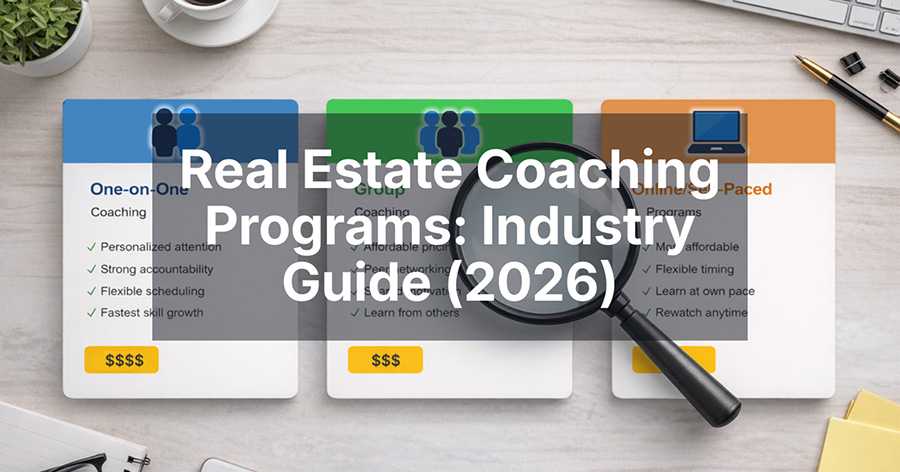
- Differences between one-on-one, group, and online coaching
- The top coaching programs in the industry (with how they compare)
- How pricing works
- The results you can expect
Let’s dive in.
What Are Real Estate Coaching Programs?
Real estate coaching programs are structured development systems designed to help agents grow their production, master key skills, build scalable business models, and maintain personal discipline. A good coaching program can encompass:
- Accountability and goal-setting: Regular check-ins to keep you on track.
- Lead generation and conversion training: How to fill and work your pipeline effectively.
- Role-playing and scripts: Practice dialogs for prospecting, objections, and closing.
- Marketing and branding guidance: Strategies to build your presence and attract clients.
- Business systems and automation: Setting up processes and tools to run your business.
- Time management and productivity: Frameworks to use your hours wisely.
- Mindset and performance coaching: Techniques to stay motivated and resilient.
- Team-building strategies: Hiring, delegating, and scaling up when you’re ready.
While every program has its own style, the most successful ones usually share three traits:
1. Individualized Guidance
Instead of going it alone by trial-and-error, you get a personalized roadmap. A coach analyzes your strengths, weaknesses, market conditions, and goals to create a custom action plan.
2. Accountability Systems
Great coaching doesn’t just teach – it ensures you implement. Whether through weekly check-ins or daily tracking, a strong program will hold you accountable to your commitments. This consistent accountability dramatically increases execution of the tasks that drive your business.
3. Skill Development & Real-World Application
From conversations to contracts, coaching helps you perform at a higher level through repetition, evaluation, and expert feedback. You’re not just absorbing theory – you’re role-playing scenarios, applying new scripts, tightening up your follow-up process, and getting immediate input on what to improve.
Types of Real Estate Coaching Programs
Not all coaching programs are created equal. Before choosing one, it’s important to understand the three primary formats available, each with pros and cons.
One-on-One Real Estate Coaching
One-on-one coaching provides direct, individualized attention between you and a coach. It’s the most personalized – and often the most intensive – form of coaching.
Benefits: This format is highly tailored to your market, experience level, and specific goals. Because it’s just you and the coach, you’ll get feedback and advice unique to your situation. Accountability tends to be very strong (it’s hard to hide or coast when you have a personal mentor calling you out). Skills can develop faster due to the focused critique and role-play. Scheduling is also flexible since you coordinate directly with the coach.
Drawbacks: One-on-one coaching is typically the highest-cost option. Quality can vary widely depending on the coach’s background – a great coach is worth it, but not all coaches have the same expertise. Also, the experience is only as good as the individual coach’s system; a less structured coach could mean a less structured program.
Best For: Agents who want fast growth, personal accountability, and a customized mentorship experience. If you thrive with individual attention and are willing to invest for a top-tier guide, one-on-one is ideal.
Group Real Estate Coaching
Group coaching involves multiple agents learning together in a structured, collaborative environment (often via weekly group calls or meetings).
Benefits: Group programs are far more affordable than private coaching. You also gain networking and community – interacting with peers can spark ideas and provide support. The shared energy of a group can be motivating; you see others tackling similar challenges. You’ll also learn vicariously through a variety of agent experiences and questions raised in sessions.
Drawbacks: Feedback is less personalized. The coach’s attention is divided, so you might not address your specific weakness in depth each session. Accountability can become more self-driven – it’s easier to “hide” in a group or just passively listen without taking action. If the group is too large or diverse in experience, some content may not feel relevant to you.
Best For: Agents who want support and community without the high cost of private coaching. If you learn well from others’ examples and don’t need constant personal attention, a group format can be very effective.
Online/Self-Paced Real Estate Coaching Programs
These include on-demand video courses, digital training platforms, membership sites, webinars, and virtual challenges that you can do at your own pace.
Benefits: Online programs tend to be the most budget-friendly. Many cost a few hundred dollars (or even free) for lots of content you can consume on your own schedule. You can pause and re-watch modules anytime. This is great for beginners who need foundational knowledge or agents who have unpredictable schedules. You’re not tied to appointments, and you can often cover the basics of real estate marketing, contracts, etc., at your convenience.
Drawbacks: No true accountability. With self-paced content, it’s on you to apply what you learn – there’s no coach checking if you did the work. Customization is very limited (everyone gets the same material). Content can also become outdated if it’s not refreshed frequently – you might be watching videos from 3+ years ago that don’t reflect current market shifts. Finally, without interaction, you miss out on role-play and real-time Q&A, which are crucial for skill-building.
Best For: Agents who prefer flexible, self-directed learning or those who need an inexpensive way to get some basics before upgrading to a live coaching program. It’s also a fit for very disciplined self-starters who can hold themselves accountable. (But be honest – most of us benefit from outside accountability!)
Top Real Estate Coaching Programs in 2026 (Compared)
Real estate coaching includes a mix of long-established brands and newer programs. Below is a comparative overview of several recognized options, including Dash 2 Success, focusing on structure, delivery model, and the type of agent each is designed to support.
Tom Ferry Coaching
Focus: Tom Ferry’s organization is the largest real estate coaching platform in the U.S., practically synonymous with real estate coaching. It offers a broad mix of training on mindset, scripts, marketing, and business planning. Tom Ferry himself is known for high-energy motivational events and a focus on getting agents to break through mental roadblocks. The coaching covers everything from lead generation techniques to social media tactics, with heavy emphasis on mindset and accountability.
Format: Primarily one-on-one coaching on a monthly subscription, supplemented by huge group events (like the annual Success Summit) and an online library of training resources. They have tiers for individual agents and teams. Some group coaching options and workshops exist as well, but the flagship is the private coach who calls you regularly. Tom Ferry’s company employs a large roster of coaches to work with hundreds of agents.
Pros:
- Huge brand recognition and community: Tom Ferry is arguably the best-known coach in the industry, and clients get access to a large network of fellow coaching members. His presence is everywhere – YouTube, conferences, social media – so you feel part of a big movement.
- Large library of resources: As a member, you unlock extensive scripts, checklists, marketing templates, and training videos. It’s a treasure trove of content for agents who want guidance.
- Strong accountability structures: The program emphasizes tracking your numbers and activities. Many agents credit Tom Ferry coaching for instilling discipline (calls, contacts, appointments) that they lacked before. Coaches often require weekly reporting and have systems to keep you accountable to your goals.
Cons:
- Higher price point: Tom Ferry coaching is one of the more expensive options. The basic “Core” plan is around $749/month, mid-tier “Elite” about $1,299/month, and team coaching $2,999/month. It’s a significant investment (usually a 12-month contract), which can be tough for newer agents.
- Quality can vary by coach: Tom Ferry has dozens of certified coaches. Not all have the same style or experience. Some clients rave about their coach, while others report a mediocre match. Your experience may depend on the particular coach you’re assigned – there’s an element of luck in getting one whose approach truly fits you.
- Less personalized than boutique programs: Because it’s a large coaching company, the system is a bit more standardized. The advice is certainly tailored to you to an extent, but it’s within the Tom Ferry framework. Agents who want a very customized or niche strategy might feel the program is a bit “one size fits all.” (It’s worth noting they do try to match coaches based on your profile, but it’s not the same as a small program built entirely around you.)
Mike Ferry Coaching
Focus: Mike Ferry (father of Tom) is a pioneer in real estate coaching, known for old-school sales techniques and an unrelenting focus on prospecting. His program centers on scripts, cold calling, and fundamental sales skills – essentially, “pick up the phone and dial.” Mike Ferry coaches drill clients on lead generation through calls, door-knocking, and other traditional methods. The style is very direct and discipline-oriented, aiming for high-volume prospecting. Many of the industry’s popular scripts for FSBOs/expireds, listing presentations, etc., originated with Mike Ferry’s training.
Format: Mike Ferry offers one-on-one coaching (typically with a 12-month contract) and some group events/retreats. Coaching calls are often weekly or biweekly 1:1 sessions focusing on your numbers and activities. The Mike Ferry Organization (MFO) also hosts large seminars and retreats geared toward prospecting mastery.
Pros:
- Proven sales fundamentals: If you want a clear, no-nonsense system to get more listings and clients, Mike Ferry provides it. There’s a strong emphasis on daily calls, script practice, and tracking contacts – the core activities that lead to deals. It’s a script-heavy, discipline-focused approach built for high-volume calling, which many top producers swear by.
- Longevity and track record: Mike Ferry has been coaching agents for decades and has thousands of success stories. His methods have been proven to increase production if followed rigorously. For team leaders in particular, he offers guidance on recruiting and scaling (since his advanced programs include team-building aspects).
- Relatively affordable for 1:1: Compared to some others, Mike Ferry’s base coaching costs around $750/month for one-on-one coaching – which is not cheap, but slightly lower entry than some big-name competitors’ one-on-one programs.
Cons:
- Style can feel outdated for modern markets: Mike Ferry’s approach is very much “smile and dial.” Agents who prefer inbound marketing, social media lead generation, or modern branding may find his methods too old-school. There’s minimal emphasis on things like content marketing or newer tech platforms. Some agents feel the training doesn’t address today’s consumer as much as it should.
- High structure, less flexibility: The program expects you to follow a fairly rigid routine (calls every morning, strict script adherence). For some, this is exactly what they need; for others, it can feel stifling or not reflective of their style.
- Requires thick skin: Mike Ferry coaching can be blunt. If you miss your numbers, you’ll hear about it. The style is famously tough-love, which not everyone responds well to. It’s effective for those who like a push, but agents seeking a gentler or more collaborative coaching relationship might be put off.
(Overall, Mike Ferry is best for agents who want hardcore accountability on prospecting and don’t mind a bit of old-school flavor. Many top agents have built great businesses on his system of scripts and routines, but make sure that approach fits your personality and market.)
Buffini & Company Coaching
Focus: Buffini & Company (led by Brian Buffini) specializes in a relationship-based, referral-focused approach to building your real estate business. The core philosophy is “Work by Referral” – generating the majority of your clients through repeat business and referrals from your sphere, rather than cold leads. Buffini coaching blends personal development with training on how to deliver exceptional service and stay in touch with your database to create long-term advocates.
Format: Buffini offers One2One Coaching (private coaching with a dedicated coach), small group options, and large events like the MasterMind Summit. A hallmark of Buffini’s system is providing marketing kits and a CRM (Referral Maker® CRM) to execute his referral strategies. Coaching members often get monthly mailer content, client appreciation ideas, and scripts for asking for referrals. Culturally, Buffini & Co. fosters a very strong community ethos – members often share a positive, supportive vibe centered on personal growth and work-life balance.
Pros:
- Great for agents who thrive on referrals: If you prefer to build a sphere-based business, Buffini is the gold standard. His training will show you how to systematically touch your past clients and network (calls, notes, pop-by gifts, etc.) to generate consistent referral leads. Many agents who don’t like aggressive cold calling find success with Buffini’s warmer approach.
- Strong community and culture: Buffini & Company has been around since 1996 and has a loyal following. Agents often describe the culture as encouraging and family-like. There’s an emphasis on personal growth, financial literacy (Buffini talks about managing your money wisely), and even spiritual well-being. The events are high-energy and inspirational, which can recharge your motivation.
- Proven materials and tools: The program includes tangible resources – a CRM to track your relationships, printed marketing kits to send clients, and a structured referral system. It’s not vague coaching; it’s a step-by-step method to deepen client relationships. The One2One coaching is also a bit more affordable than some others (around $549/month for individual coaching), and that includes a lot of marketing collateral which might otherwise cost money.
Cons:
- Limited emphasis on prospecting and new lead-gen: Buffini’s approach intentionally deemphasizes cold prospecting and paid leads. If you don’t already have a decent network or you want to scale via online leads, the Buffini system might feel slow. (One Reddit user noted that Buffini took them from 20 to 55 deals a year, but “results will be slower than paid lead gen” – it requires patience as you build up referrals.) In very competitive markets or for brand-new agents without a sphere, this can be a drawback.
- Not ideal for every market niche: The relationship-first model works best in residential real estate with repeat customers. Agents in ultra-fast-paced markets or transactional niches (e.g., REO, short sales, investment properties) might find the Buffini method less directly applicable. If your clientele isn’t the type to give frequent referrals (say, investors who care only about numbers), Buffini coaching might not address how to generate business otherwise.
- Less focus on modern marketing tactics: While Buffini has added some training on social media and such, it’s not his primary focus. Those who want deep coaching on Instagram branding, YouTube lead gen, or running Google ads will not get that from this program. It sticks to the fundamentals of referral and client care.
(In summary, Buffini & Company is a top choice for agents who believe in a people-first business. If you want your business to be 85% referrals and repeat clients, and value a supportive community, Buffini’s coaching will likely be worth it. Just know that it’s a different philosophy from the high-churn lead generation models.)
Dash 2 Success Real Estate Coaching Program
Focus: Tightening core business systems and execution habits — building a repeatable weekly cadence that controls your calendar, follow-up cadence, pipeline management, decision cycles and weekly execution. The program is led by Gina Giampietro, a top 1% producing agent still actively running these systems, who teaches the same structure she uses in her own business.
Format: Cohort-based, eight-week live program delivered online with small cohorts. Each week features live sessions taught directly by Gina Giampietro, assignments for immediate application, and weekly scorecards for accountability. Participants receive worksheets, templates, scripts and planners, and have access to a private cohort community for support. There is no at-your-own-pace option; the program follows a defined weekly rhythm and is designed to finish within eight weeks. Fit Snapshot: Suited for agents with active business or leads who want structure, clear expectations and steady growth; not ideal for brand-new agents without prospecting activity or those seeking done-for-you lead generation. It is positioned for agents who prefer a time-bound program with guided implementation and accountability rather than an open-ended monthly membership.
Pros:
- Hands-on implementation: Designed around doing the work between sessions, not just consuming content.
- Metrics-forward approach: Uses activity and conversion tracking to make progress visible over the eight-week window.
- Accountability structure: A defined cadence and reporting can reduce drift for agents who struggle to self-direct.
- Current-market lens: Led by an active agent, which may help keep examples and tactics aligned with present conditions.
Cons:
- Requires consistent participation: The format generally expects weekly attendance and follow-through between sessions.
- High-accountability style isn’t universal: Agents who prefer a lighter-touch approach may find the pace or reporting requirements too structured.
- Time-bound schedule: The eight-week cohort model is helpful for focus, but it requires aligning your calendar with the cohort dates.
Market note: As a newer program relative to legacy brands, independent third-party reviews may be more limited. Prospective clients should ask for recent examples, outcomes definitions, and references where available.
(In summary, Dash 2 Success is a structured eight‑week coaching program focused on operational execution rather than motivation or endless content. Agents who value guided implementation, a clear weekly rhythm and small‑group accountability may find this program effective. Those seeking open‑ended memberships, deep marketing tactics or less structured coaching may prefer other options. Always verify the current curriculum, schedule, pricing and support directly with Dash 2 Success.)
Workman Success Systems (Verl Workman)
Focus: Workman Success Systems, founded by Verl Workman, is focused on teams, operations, and scalability. It’s essentially a business coaching program for real estate, often used by top teams and broker-owners. The coaching covers building efficient systems, recruiting agents or assistants, tracking metrics (the “4 Rs” of running an office: Recruit, Ramp, Reward, Retain), and creating sustainable growth. The goal is what Workman calls “Predictable Greatness” – a business that runs on well-defined processes and consistently generates high performance.
Format: Workman Success offers private coaching typically geared toward teams (though they have individual agent coaching as well). They often start with a thorough business audit or assessment, then assign a coach who works with you (and sometimes your whole team) on implementing the Workman systems. They also provide extensive playbooks, checklists, and tracking tools. For example, Workman clients use tools for tracking lead sources, conversion ratios, and employee productivity. The program might include coaching not just for the team leader, but for various roles in a team (buyer agents, admin staff, etc.), and often involves the entire team in training sessions. Workman Success also partners with brokerages and does corporate training, which is why it sometimes has a more corporate coaching feel.
Pros:
- Ideal for growing teams and brokerages: If you’re at the stage of wanting to build a team or improve your brokerage’s performance, Workman specializes in that. Their coaching covers hiring plans, compensation models, team structure, and leadership skills in addition to sales skills. Many other coaching programs focus only on individual agent production, whereas Workman can guide you through doubling the size of your team, implementing formal systems, etc.
- Great operational tools and systems: Workman Success provides very concrete materials – think operations manuals, onboarding processes, lead routing systems, detailed job descriptions, and so on. They have a “systems-first” approach where for every aspect of your business, there’s a documented process or checklist. This is a huge plus for agents who need help getting organized and systematized. Over time, these systems can make your business more efficient and even increase its valuation if you ever sell it.
- Metrics and accountability around business health: The coaching will likely have you tracking not just your sales, but also things like profit margins, per-agent productivity, and customer service metrics. It’s a comprehensive approach to running a real estate business like a true enterprise. Many Workman coaches have backgrounds as former brokers or team leaders themselves, so they bring a lot of experience in management.
Cons:
- Less relevant for solo agents at early stages: If you’re a brand-new or solo agent doing <10 deals/year, Workman’s full program might be overkill. It’s tailored for those who already have a steady business and want to go from good to great by scaling up. (They do have content for individual agents, but the real value shines when you have a team context.) For a solo agent, the coaching might feel too focused on things like recruiting or operations that aren’t yet applicable.
- More “corporate” style: Because Workman Success often deals with broker/owners and teams, the coaching has a corporate consulting vibe. The materials and language can be a bit formal (talk of KPIs, profit and loss, etc.). Some agents might find this approach less personable or motivating on a personal level. In other words, it’s not as touchy-feely or motivational as some coaching; it’s very business-centric. If you prefer a warm, high-enthusiasm coach to pump you up, Workman’s style of analytically drilling into your business metrics might not be the right fit.
- Cost structure not publicly clear: Workman doesn’t publish prices openly (often “book a call for pricing”), and they typically do longer engagements. Expect that it’s on the higher end (likely in line with other elite coaching, possibly $1,000-$2,000+/month depending on if you’re a team/brokerage). The lack of public pricing means you have to commit to a consultation first. This isn’t a huge con, but transparency-wise it can be a consideration.
(In short, Workman Success Systems is great for agents who want to treat their business like a business. If words like “systems, processes, scalability” get you excited, and you aim to lead a team or firm, Workman’s coaching could be extremely valuable. If you’re a solo agent just trying to stay afloat, you might look at other programs first and come back to Workman when you’re scaling up.)
How Much Do Real Estate Coaching Programs Cost?
Real estate coaching pricing varies widely by format, duration and level of access. Self‑paced online courses are generally the most affordable, with one‑time fees ranging from roughly $100 to $1,000. Group coaching programs are typically billed monthly and often fall between about $200 and $600 per month. One‑on‑one coaching usually starts around $500–$750 per month and can exceed $2,500 for high‑touch or team‑focused programs. Elite or executive coaching may cost $2,000 or more per month. Because many providers do not publish their prices publicly, confirm the cost, commitment and payment options directly with the coach or company. Dash 2 Success, for example, charges a one‑time enrollment fee for its eight‑week cohort — $2,995 when enrolling by March 31, 2026 (a $500 savings) and $3,495 thereafter. Always verify current pricing and terms before committing to any program.
Where Dash 2 Success Fits: Dash 2 Success is typically sold as a one-time enrollment for an eight-week cohort. When comparing it to monthly coaching, it can be useful to translate the total fee into an approximate “per month” cost across the program duration and then compare the level of access, accountability, and support. Always verify current pricing and terms directly with the provider.
Expected Outcomes From Real Estate Coaching
What kind of results can you expect from a real estate coaching program? Results will always vary based on an agent’s commitment, the quality of the coach, and market conditions. However, coaching consistently shows one of the highest returns on investment (ROI) of anything you can spend money on in your business.
In fact, a study of several brokerages found that agents who received regular coaching increased their production by 21% year-over-year, on average – whereas agents with no coaching saw a 9% decrease in production in that same period. Those who had four or more coaching sessions in a year boosted production by 28% on average. The data is clear that coaching correlates with higher sales performance.
Common Outcomes Reported:
- Higher lead conversion rates: You should start turning a greater percentage of your leads into signed clients and closed deals, thanks to improved scripts and follow-up systems.
- More transactions and GCI: Many agents double or even triple their annual transaction count after a year of focused coaching and execution. It’s not uncommon to hear testimonials of going from, say, 10 deals to 20+, or from $50k GCI to $150k, over 12–18 months of coaching.
- Clear daily structure: One immediate benefit (often within the first 30 days) is gaining clarity on what you need to do each day. A good coach will help you map out an ideal weekly schedule – prospecting time, appointment slots, admin time – so you stop feeling overwhelmed and start following a routine.
- Reduced overwhelm and burnout: By focusing on the critical activities and having systems to lean on, agents often feel less scatterbrained. Coaching can help you work smarter, not just harder, which reduces stress.
- Stronger branding and marketing presence: Many coaching programs push agents to implement marketing campaigns – whether that’s consistent social media posting, a mailing plan to a farm, or better listing presentation materials. Over 6–12 months, this significantly boosts your brand recognition in your market.
- More predictable pipeline and income: Instead of the feast-or-famine cycle, you develop a pipeline that produces deals more evenly. Coaches often have you track your numbers so you can forecast and set more realistic income goals.
- Better handling of objections and tough situations: Through role-play and experience sharing, you become much more confident in scenarios like pricing discussions, low offers, difficult clients, etc. Objections that used to make you stumble will become second nature to address.
- Personal confidence and discipline: Perhaps most importantly, agents come out of coaching with a new level of confidence – knowing they have a plan and the skills to execute it. Discipline becomes a habit. This mindset shift can permeate everything, creating a virtuous cycle of success breeding success.
The Secret to Results: Consistency. Coaching itself won’t magically make you money – your effort applied consistently is what produces results. What a great coaching program does is give you the structure, knowledge, and accountability to be consistent even when motivation dips. This consistency over time is what leads to the dramatic increases in production that many coaching clients experience. As one industry coach put it: real estate coaching isn’t about secret lead gen hacks, it’s about mindset, accountability, and consistency. Those fundamentals yield the highest ROI.
How to Choose the Right Real Estate Coaching Program
Selecting a coaching program shouldn’t be guesswork or just based on whoever has the flashiest ads. Use the following criteria to evaluate your options and find the best fit for you:
- Clarity of System
Does the program have a clear, defined system or curriculum? The best coaching programs provide a step-by-step framework (daily schedules, weekly themes, specific playbooks). Beware of any coaching offer that sounds vague – e.g., “we’ll talk about whatever you need.” While flexibility is nice, you want a coach who has a proven game plan for boosting real estate business, not just generic motivational chatter. Look for details on what exactly you’ll be learning or doing each month. A structured plan (which you can, of course, personalize) usually beats a completely ad-hoc approach.
- Accountability Mechanisms
Find out how the program enforces accountability. Do they have you turn in numbers each week? Is there a dashboard or tracking form? Will someone call you out if you disappear? Strong coaching programs have built-in accountability – scorecards, weekly check-ins, homework assignments – rather than relying on you to self-motivate. If a program is mostly “watch these videos and good luck,” you might not see much benefit. Decide how much accountability you need, and pick a program that provides it in that measure.
- Coach Quality & Experience
Ultimately, who you work with matters greatly. Research the coaches or instructors involved. Do they have real real estate experience and success? Not all coaches have been top agents themselves (and that’s okay if their coaching track record is strong). Some were brokers, some were agents, some are just great trainers. Ask for their bio or track record. Look for client testimonials or case studies that mention specific coaches by name and the results they helped achieve. If possible, request a short introductory call with the potential coach to gauge their style. You want someone you respect, who inspires you, but also someone who understands the business at a level that can truly help you.
- Training Format That Fits Your Learning Style
Think about how you learn and take action best. Do you need personal, direct attention (one-on-one)? Do you enjoy bouncing ideas in a group setting (group coaching)? Are you super self-driven (maybe an online course could work)? Align the program format to your personality. For example, if you know you tend to hide in groups and not speak up, then one-on-one might be better to force engagement. If you love camaraderie and feeling part of a team, a group program might energize you. Also consider logistics: if you can’t commit to a same time every week, maybe a more asynchronous program is necessary. The right format is one that you will consistently show up for – because consistency is the key to results.
- Evidence of Real Results
Don’t take coaching sales pages at face value – look for evidence that the program delivers. Ask for case studies or examples of agents who improved their business after joining. Many good coaching programs will have video testimonials with actual numbers (e.g., “I went from 8 deals to 20 deals in a year”). If a program can’t point to any tangible success stories, that’s a red flag. It’s also useful to ask within your agent network or online groups for reviews of the program – peer feedback can be invaluable. Remember, you’re investing money in this; you should treat it like hiring an employee or buying a tool – due diligence is expected.
Finally, once you’ve vetted these aspects, trust your gut on which program resonates most with your goals and values. The best coaching program for you is one that aligns with the way you want to do business and the improvements you seek. It should feel like a partnership that will push you, not just a product being sold to you.
(Tip: Consider starting with a short-term or trial option if available. Some coaches offer a free strategy session or a month-to-month plan. You can also start with a lower-tier offering (like a group course) to “test drive” how they deliver coaching, then upgrade if it’s a fit.)
Frequently Asked Questions About Real Estate Coaching Programs
Is real estate coaching worth it?
In most cases, yes, coaching is worth it – provided you are ready to take action. Coaching consistently correlates with higher production and more predictable results. Industry data shows that agents who engaged in regular coaching increased their sales by 20–30% on average, compared to agents with no coaching who actually saw declines. Think of coaching as hiring a personal trainer for your business: if you put in the work, you will almost certainly see a positive ROI (often many times over). Beyond the numbers, coaching can also reduce stress by giving you control over your business instead of feeling like the business controls you. That said, if someone isn’t receptive to coaching or picks the wrong coach, it could be a waste – success requires a good fit and a commitment to follow the process.
How long does it take to see results?
It depends on the type of results you’re looking at. Many agents report seeing some improvements in the first 30 days – often in their personal organization and clarity. You might feel more focused each day and have better time management within a month. By 60–90 days, you should start to notice lead conversion improving and more consistency in your prospecting or marketing efforts (e.g., you’re making calls every week, appointments are happening more regularly). A full business transformation can take 6–12 months of solid work – for example, doubling your annual transactions or hitting a big GCI goal usually won’t happen overnight, but if you stick with coaching for a year, those outcomes are common. Remember, real estate cycles can be 3-6+ months from lead to close, so production gains often lag the activity gains by a quarter or two. The key is to maintain consistency; results will compound over time.
What if I’ve tried coaching before and it didn’t work?
If coaching didn’t work for you in the past, consider a few possibilities. First, you might not have had the right coach or program for your needs. Sometimes the style or system isn’t a match, which can lead to disengagement. Second, there may not have been true accountability – some programs let you slip through the cracks too easily. Without accountability, even good advice won’t stick. Third, think about your own engagement: were you truly committed, and did the program require commitment? The best coaching will challenge you to get out of your comfort zone; if it was too easy to ignore, that’s a problem.
The good news is that coaching formats vary widely. If a past experience felt like “content without implementation,” look for programs with a clear curriculum, defined deliverables between sessions (scorecards, assignments), and a cadence of accountability that matches how you work. If it felt overly rigid or mismatched to your market, look for coaches who can tailor the plan without making the system vague.
Can new agents benefit from coaching?
Absolutely – new agents can benefit tremendously from coaching. In fact, getting a coach early in your career can help you avoid common mistakes that many agents make in their first few years. A good coaching program will give a new agent structure (when you have zero deals, having a plan for each day is crucial), teach foundational skills like prospecting and presentation, and shorten the learning curve to your first few transactions. Many programs (including Dash 2 Success) have had great success with newer agents, instilling good habits from day one so they don’t develop bad habits that have to be broken later. The key is to ensure the coaching is tailored to a newer agent’s challenges – things like building a database from scratch, budgeting on a tight income, gaining confidence, etc. If you’re new, look for programs or coaches that explicitly mention working with rookies or have beginner-level curriculum. With the right support, a new agent can achieve in 6-12 months what might take 3-4 years on their own.
Conclusion
A strong real estate coaching program is one of the most powerful investments you can make in your career. In an industry where it’s easy to get overwhelmed or stuck in place, the right coach or system will provide clarity, strategy, and accountability – the ingredients for consistent growth.
Whether you opt for one-on-one mentorship, the camaraderie of a group, or a structured online course, the key is to choose a coaching partner aligned with your goals, learning style, and stage of business. As we’ve seen, the top programs each have their niche: some excel at mindset and motivation, others at hardcore sales tactics, others at referral marketing or team building. There’s no one-size-fits-all answer. Take the time to evaluate which approach addresses the gaps in your business. And remember, coaching is not a magic pill – but if you commit to the process, it can dramatically accelerate your results and lower your stress along the way.
In 2026’s competitive landscape, the agents who continue to thrive will almost universally be those who embrace constant improvement. Coaching, in whatever form suits you, is a proven way to ensure you’re improving deliberately and not just through trial and error. It’s about shortening the distance between where you are and where you want to be.
So, do your research, ask the right questions, and when you find the program that feels right, dive in. The combination of your hard work + a great coaching system can take your business to levels that would be tough to reach on your own.
If you decide to invest in coaching, treat it like any other business decision: confirm the curriculum, support model, time expectations, and how outcomes are measured. The right fit is the one you will consistently show up for — and that is often what determines whether coaching becomes an expense or a true growth lever.
